
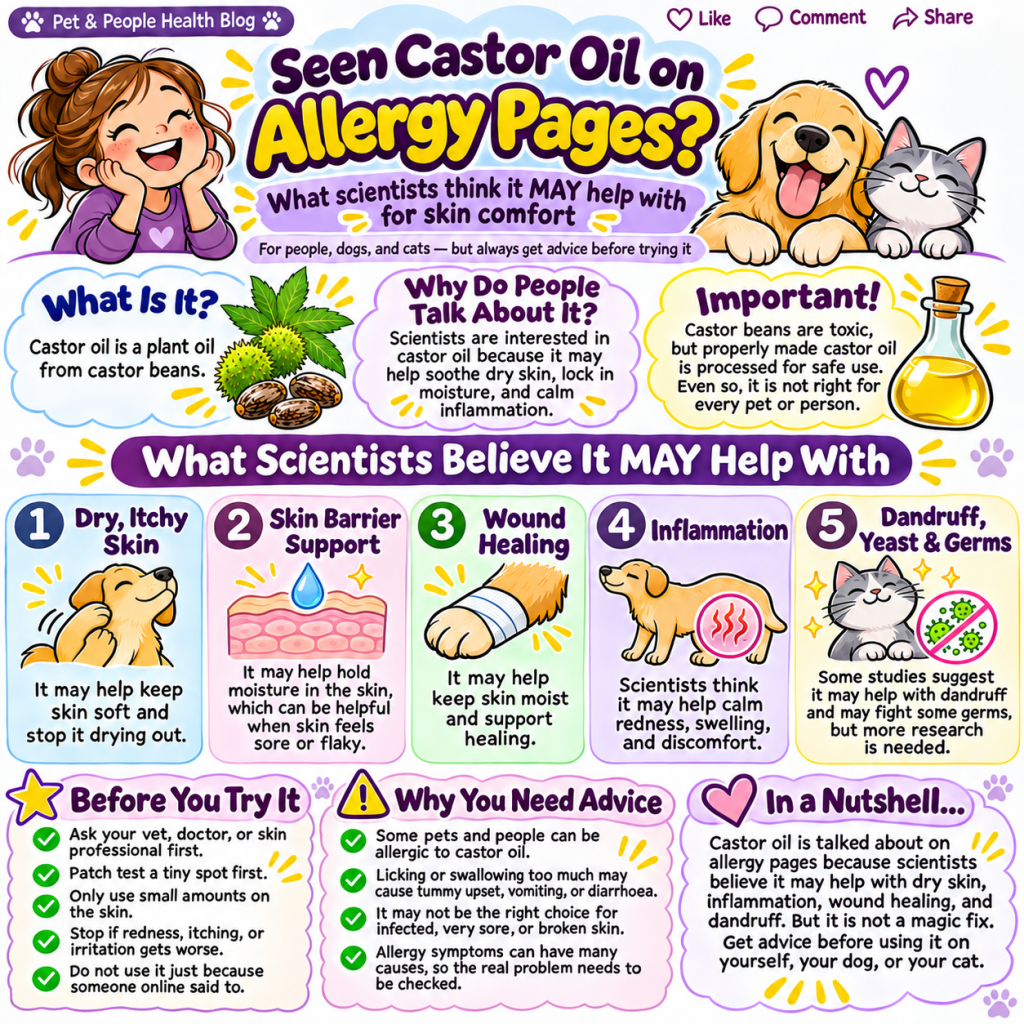
Have you noticed how often castor oil is being recommended on dog/cat/pet allergy social media pages lately?
Itchy paws? Try castor oil. Yeast infections? Castor oil. Arthritis, dandruff, sore elbows and even wounds? Apparently, castor oil is the answer to everything!
But is it really that good? And more importantly, is it safe for our dogs and cats?
At Coco Kaboo, we love exploring natural ways to care for our pets. But we also believe it’s important to understand what an ingredient can actually do, what scientists have discovered and what the possible risks might be.
Because there’s a big difference between something working in a laboratory and being a proven treatment for your pet.
So, before you reach for that bottle of castor oil, let’s take a closer look.
Castor oil is a thick vegetable oil made from the seeds of a plant called Ricinus communis.
People have used it for thousands of years, particularly for skincare and as a laxative.
What makes castor oil interesting is something called ricinoleic acid.
That’s a bit of a mouthful, isn’t it?
Put simply, it’s a natural fatty acid that makes up around 85 to 90% of castor oil.
Scientists have been studying it because some experiments suggest it may help reduce inflammation. Castor oil is also known for its ability to soften skin and reduce moisture loss.
That sounds promising, but there’s something important to remember.
Most of this research has involved people, laboratory experiments or specially made products. Very little has been studied directly in dogs and cats.
With that in mind, let’s explore five areas where castor oil may have something to offer.
One of castor oil’s better understood benefits is its ability to help skin hold onto moisture.
Think of your pet’s skin like a protective wall. When it’s healthy, it helps keep moisture in and unwanted irritants out.
When that protective barrier becomes damaged or too dry, the skin may become flaky, itchy and uncomfortable.
Castor oil contains fatty acids that can help soften skin and reduce moisture loss. This is one reason it’s used in some human skincare products.
This is where things get interesting.
A dog with an environmental or food allergy may have itchy skin, but that doesn’t necessarily mean the skin simply needs more moisture.
For example, a dog constantly licking its paws could be reacting to something in its environment, dealing with a yeast infection or suffering from another skin problem altogether.
Applying castor oil might help some dry areas feel softer, but it won’t necessarily address what’s making your pet itchy in the first place.
There is currently insufficient reliable research showing that castor oil treats allergies in dogs or cats.
Our recommendation: Before applying any new oil, try to understand why your pet’s skin is irritated.
For dogs needing help with dry or uncomfortable skin, we developed Itchy Bark, our natural topical treatment formulated effective and safe natural essential with coconut and calendula oils.
It’s designed to help moisturise and soothe irritated skin as part of a broader skin care routine.
Explore Coco Kaboo’s Itchy Bark Skin Treatment
Arthritis is something many older dogs experience, although younger dogs can develop joint problems too.
You might notice your dog taking longer to get up, becoming reluctant to jump into the car or seeming stiff after sleeping.
Inflammation can contribute to the pain and discomfort associated with arthritis.
Researchers have investigated ricinoleic acid, the main fatty acid in castor oil, because it has shown anti-inflammatory effects in some experimental studies.
In certain animal experiments, ricinoleic acid helped reduce swelling and inflammation.
That’s encouraging, but these experiments weren’t clinical trials involving dogs with arthritis.
We also don’t know whether rubbing ordinary castor oil onto a dog’s skin allows enough of the active ingredient to reach the affected joint to provide meaningful relief.
So, can castor oil treat arthritis in dogs?
At this stage, there simply isn’t enough reliable evidence to say that it can.
At Coco Kaboo, we believe joint care should look at more than one thing.
Good nutrition, maintaining a healthy weight, appropriate movement and managing discomfort can all play a part in keeping our pets mobile.
We’ve developed two products for owners interested in natural joint support.
A Key Bones is our nutritional joint supplement containing glucosamine, chondroitin, MSM, turmeric, ginger and other selected ingredients to support joint health and mobility.
Old Mate is our topical botanical oil blend, designed for external application for pain relief as part of a joint care routine.
Explore our natural joint support range:
A Key Bones – Nutritional Joint Support
Old Mate – Topical Joint Care Oil
Scientific research: Effect of Ricinoleic Acid in Experimental Models of Inflammation
Have you ever noticed those thick, rough, hairless patches that sometimes develop on a dog’s elbows?
They’re called calluses, and they’re particularly common in larger dogs or dogs that spend a lot of time lying on hard surfaces.
Sometimes they’re simply dry and rough. Other times, the skin can crack or become damaged.
So, could castor oil help?
Castor oil has been used as an ingredient in certain medical wound care products for people.
One study examined more than 2,000 pressure ulcer cases involving 861 nursing home residents.
Researchers compared different treatments, including a specialised ointment containing hydrogenated castor oil, balsam of Peru and trypsin.
The study found that the combination ointment was associated with better healing outcomes in some comparisons.
However, there’s a very important difference between that product and ordinary castor oil.
The researchers studied a specially formulated medical ointment containing several ingredients, not castor oil straight from a bottle.
We also cannot assume that the results in people will be the same for dogs or cats as their was not risk that the nursing home residents where going to lick it, a risk that we need to consider in our animals.
Castor oil’s moisturising properties may help soften rough skin, but it hasn’t been proven to heal canine pressure sores.
At Coco Kaboo, our Itchy Bark Treatment Oil is used for dry, irritated and damaged skin, including some open sores where appropriate.
However, an open sore is not always a simple skin problem. Deep wounds, pressure ulcers, infected areas and wounds that aren’t healing require veterinary assessment.
Don’t forget the importance of reducing pressure on the affected area. Soft, supportive bedding can make a real difference, especially for larger or older dogs.
Scientific research: Comparison of Pressure Ulcer Treatments in Long-Term Care Facilities
This is a particularly important topic because we regularly see people asking for natural remedies for yeast and bacterial skin problems.
Smelly paws, brown staining, red skin and constant licking often lead owners to assume their dog has a yeast infection.
But those symptoms can have several different causes.
Some laboratory research has found that certain castor plant extracts and compounds derived from castor oil can affect the growth of particular bacteria.
That sounds promising, but there’s a catch.
Something that affects bacteria in a laboratory isn’t automatically an effective treatment when applied to a dog’s skin.
There’s also a difference between specially prepared plant extracts, modified fatty acids and ordinary castor oil.
At present, there isn’t enough reliable clinical evidence to recommend castor oil as a treatment for yeast or bacterial skin infections in dogs and cats.
Yeast naturally lives on the skin of many healthy dogs.
Problems can develop when something allows too much of it to grow.
Allergies, moisture, damaged skin and certain underlying health conditions can all play a role.
Signs that may suggest a skin problem include:
But here’s something we always encourage pet owners to remember.
Two dogs can have almost identical symptoms for completely different reasons.
A veterinarian can perform a simple test called skin cytology. This involves looking at a small skin sample under a microscope to check for yeast and bacteria.
It helps take the guesswork out of deciding what treatment is needed.
While an infection needs to be correctly identified and managed, caring for the surrounding skin is also important.
Our Itchy Bark Treatment Oil was developed to help soothe and moisturise uncomfortable skin using a blend of botanical ingredients, including coconut and calendula.
It may be considered as part of a skin care routine where appropriate, but it should not be relied upon to eliminate an active bacterial or yeast infection.
Our recommendation: Before treating what you believe is yeast, make sure you understand what’s actually happening with your pet’s skin.
Veterinary reference: 2023 Guidelines for Allergic Skin Diseases in Dogs and Cats
Just like people, dogs and cats can develop dandruff.
Sometimes you’ll notice little white flakes appearing when you brush your pet or give them a cuddle.
It can be tempting to assume their skin simply needs more oil.
And sometimes dry skin really is part of the problem.
Because castor oil helps soften skin and reduce moisture loss, it may be useful as a moisturising ingredient.
However, there’s no strong veterinary research showing that castor oil specifically treats dandruff in dogs or cats.
Flaky skin can also be associated with:
Some dogs even develop greasy flakes rather than dry ones.
Applying more oil to already greasy, irritated skin isn’t necessarily going to help.
Our recommendation: If your dog has genuinely dry, flaky skin, a suitable moisturising product may help improve comfort.
Our Itchy Bark Treatment Oil is one option for supporting skin moisture and comfort in dogs.
However, if the flaking continues, becomes greasy or is accompanied by itching, redness or an unusual smell, it’s important to investigate the cause.
Remember, dandruff is a symptom, not a diagnosis.
We’ve explored what makes castor oil interesting, but before deciding to use it on your pet, there are some important risks to understand.
Just because something comes from a plant doesn’t automatically mean it’s safe.
After all, chocolate, grapes and certain garden plants are natural too, and we certainly wouldn’t recommend feeding those to our dogs!
Although castor oil is used in many human skincare products, some people have developed allergic contact reactions to it or its components.
That means an ingredient intended to soothe the skin can sometimes cause more irritation.
We don’t have enough good research to know exactly how often this happens in dogs and cats.
If your pet already has very inflamed or damaged skin, adding another ingredient without understanding its suitability may make matters worse.
Dogs lick their paws. Cats groom themselves constantly.
So anything applied to their skin or fur has a chance of ending up in their mouths.
Castor oil is a stimulant laxative. That means it encourages the intestines to move their contents along.
When swallowed, it can cause problems such as:
Never give castor oil orally to your dog or cat without veterinary direction.
Even when using a product externally, consider whether your pet may lick it off.
Here’s something that surprises many people.
The seeds of the castor plant contain a powerful toxin called ricin.
Properly manufactured castor oil is processed to separate the oil from the ricin-containing seed material.
That makes commercially processed castor oil very different from raw castor beans.
However, raw castor beans and homemade preparations can be extremely dangerous to animals.
If your pet eats castor oil, beans or any part of the plant, seek urgent veterinary advice.
In Australia, you can contact the Animal Poisons Helpline on 1300 869 738.
Perhaps the biggest concern with following social media recommendations is that the real cause of your pet’s symptoms can be overlooked.
Imagine two dogs constantly chewing their paws.
One has an environmental allergy. The other has a bacterial skin infection.
They may look like they’re suffering from exactly the same problem, but the treatment they need could be very different.
Applying castor oil to both dogs doesn’t mean either is receiving the care they actually need.
And while you’re trying different home remedies, the underlying condition could be getting worse.
Our recommendation: Before trying another treatment, take some time to investigate what’s happening with your pet.
If your dog is constantly scratching, licking their paws or developing recurring skin problems, you’ll know just how frustrating it can be.
One person recommends coconut oil. Another suggests apple cider vinegar. Someone else swears by castor oil.
Before you know it, you’ve spent a small fortune on products, your dog is still uncomfortable and you’re no closer to understanding why the problem keeps returning.
At Coco Kaboo, we encourage pet owners to look beyond the itch.
Could something in their diet be contributing? Is there something in their environment worth investigating? Or could an infection or another medical condition be involved?
Different problems can produce very similar symptoms. Finding out what’s actually happening can save a great deal of unnecessary trial and error.
If you’re interested in exploring the foods and environmental items in your pet’s daily life, we’d encourage you to take a look at our Pet Intolerance and Sensitivity Test.
Our test uses a small fur sample and bioresonance technology to assess responses to 430 food and environmental items.
That includes:
You’ll receive a personalised report with information about the items assessed and practical guidance to help you review your pet’s diet and environment.
It’s a non-invasive service for owners who are interested in exploring these areas in more detail.
We offer the test as an exploratory service, not as a replacement for veterinary diagnosis.
If a food allergy is suspected, a properly managed elimination diet followed by a food challenge remains the recognised way to investigate it.
For pets with ongoing skin infections, severe itching or other concerning symptoms, veterinary assessment is also important.
Our approach is to encourage owners to look at the bigger picture rather than continually introducing another product without considering possible contributing factors.
Interested in exploring your pet’s diet and environment?
Discover Coco Kaboo’s Pet Intolerance and Sensitivity Test
Castor oil is certainly an interesting natural ingredient.
Its moisturising properties are well recognised in skincare, and research into ricinoleic acid has shown potential anti-inflammatory effects.
But we’re still a long way from being able to say that ordinary castor oil is a proven treatment for allergies, arthritis, yeast infections or wounds in dogs and cats.
At Coco Kaboo, we’re passionate about natural pet care, but that doesn’t mean every natural remedy is suitable for every animal.
What works for one dog may not be appropriate for another, especially when we’re dealing with damaged skin, ongoing infections or underlying medical conditions.
Our advice is simple: understand what you’re treating, investigate the possible causes and choose products that are appropriate for your individual pet.
And the next time someone on social media recommends castor oil as the answer to everything, you’ll have a little more knowledge to help you decide whether it’s really worth considering.
Coco Kaboo | Healing Pets Naturally
We believe pet owners deserve access to the research behind the information they’re reading. The following studies and veterinary resources provide further information about castor oil, skin health and allergy management.
This article is intended for general education and does not replace individual veterinary advice. If your pet has severe itching, persistent skin problems, infected wounds or ongoing pain, seek appropriate veterinary assessment.
Prepared by Coco Kaboo accredited with the International Practitioners of Holistic Medicine